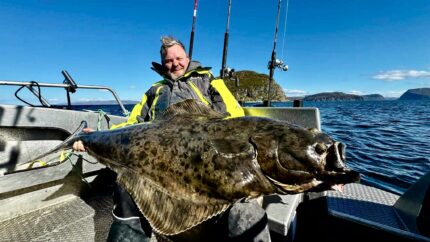
Autumn fishing – one of the best times of the season
Read more

Winter fishing for Skrei (Winter cod) in Norway is an unforgettable experience that combines some of the world's most rugged nature with world-class sea fishing. Winter fishing in Norway is an experience that takes every angler's breath away!

Massive shoals of Skrei travel well over 1000 kilometres to spawn, a process that spans the area from the fjords of Finnmark to the Vestfjord in the Lofoten Islands.
Many different factors come into play here; water temperature and currents play crucial roles. The fish follow a precise schedule dictated by nature.
The ocean current varies depending on the phases of the moon, and it is precisely these conditions that the enormous schools of capelin take advantage of. Capelin is a species of fish belonging to the smelt family. It is silver-colored and slender in shape. In many ways, capelin can be considered one of our most important species. It serves as prey for cod and forms the foundation of our rich cod (skrei) fishery.
However, it is not only the skrei that is interested in capelin. Large schools of dolphins, and orcas following the capelin schools, and humpback whales, whose powerful blows can be heard from distances, all arrive in the north at this time of year to take part in this abundant feast.
From there, they continue along the shoreline. Some head into nearby fjords to spawn, while the majority move further south, eventually reaching the region around Sørøya and Loppa. Many of the fish end their journey here, gorging themselves on the abundant baitfish before spawning. The rest continue south, passing Tromsø and its fjords and the Vesterålen islands, all the way to the Lofoten islands.


This phenomenon draws anglers from all over the world to Norway, and we at Din Tur are proud to offer the very best of Norwegian winter fishing. With snow-capped mountains and an ice-blue sea as our backdrop, we provide top-notch accommodation and comfortable boats specially adapted to the unique conditions of the northern winter. As a guest at one of our tailor-made winter fishing destinations, you will be fully equipped with everything you need for your trip.


It is a place where dreams come true. At our Camp Sørøya Rorbur og Havfiske on the island’s north side, you have the chance to encounter the first big fish; the boat ride to the fishing grounds takes anywhere from 10 to 50 minutes. Here, the fish can be found at depths ranging from 50 to over 300 meters. The Sørøyasund strait—located just a few minutes by boat from our Sørøya and Neverfjord facilities—is also a reliable spot for finding *Skrei*.
Our camp on Sørøya provides all the equipment, tackle and clothing you need.
Daily guiding services can be booked on-site.
Large 26-foot cabin boats, equipped with Webasto heating systems, ensure a perfect fishing experience at this time of year.
Sørøya Rorbu og Havfiske | DinTur.no
For those who prefer not to fly quite so far north, the Burøysund Brygge Camp should be on your list; it is the perfect destination for targeting the highly prized skrei.
The Lofoten Islands also offer excellent bases, such as our “Lofoten North Light Fishing” Lofoten North Light and Fishing Brettesnes | DinTur.no
Mølnarodden complex located on the famous Nappstraumen fishing grounds. A major advantage here is the ability to fish in almost any weather; thanks to the Nappstraumen’s connection to the open waters off the outer coast of Lofoten, anglers have access to some of the very best fishing hotspots.
The difference between winter cod (Skrei) fishing and the summer months is that the cod are often found over large areas at depths of around 100–200 meters. However, they aren’t necessarily on the bottom; the fish often hold in mid-water, at depths of 40–80 meters. When searching for them, it is important not to simply keep moving just to spot them on the fish finder; the echosounder on rental boats often lack powerful transducers, meaning you might easily pass right over the fish without seeing them on the screen. My tip: head to the spots where you suspect the fish are, wait a few minutes, or simply drop your lures down—even beyond the 100-meter mark—as the fish will follow the bait upwards. If you get contact without seeing a signal on the fish finder, keep reeling steadily to lure the fish further up in the water. Once you’ve located the fish, it is crucial to keep a lure in the water at all times to keep them interested.

Many anglers rely on the traditional metal jig (*Pilker*), often with one or two red rubber “makk” flies attached above it. While this certainly works and catches fish, you’ll quickly find yourself hooking lots of small fish—often foul-hooked in the belly or back—which can be exhausting and quickly tire out your arms.
I consistently use soft plastic lures (*Gummifisch*). Size isn’t necessarily the deciding factor; lures around 20–30 cm is perfect, though 30 cm is the upper limit for me. It’s not always about size—technique is what lands the big fish. I fish almost exclusively in the upper water layers, which has the added benefit of allowing many fish to be released.
I fish almost exclusively in mid-water, regardless of whether it is summer or winter. Let the lure sink to the bottom—or to the depth where you suspect the fish are, if using marked line—and reel it in slowly until you contact a fish; if you don’t get a bite, simply try again. This allows you to target larger fish selectively; by fishing above the school, you have a better chance of hooking a fish exceeding the 30 kg mark. Generally, this method works everywhere, though it tends to yield significantly larger fish in the north, where fish density is much higher.


Rods in the 20–30 lb class with a length of 1.90–2.10 m are perfectly adequate. I personally prefer travel rods, as they fit in a suitcase or can even pass as carry-on luggage (depending on individual airline regulations). Multiplier reels in the PE 4 class, paired with line boasting a breaking strain of around 25 kg, are more than sufficient. It is best to use multi-coloured line, as this makes fishing much easier by allowing you to quickly determine the correct water depth.

Anyone visiting Norway in winter needs more than just the right fishing gear; proper clothing is crucial. The market today offers a huge selection of floatation suits that keep you warm and—importantly—provide good buoyancy. It is also vital to wear the right layers underneath, and wool is the best material available for this. I frequently see people wearing the most expensive suits who end up freezing after just an hour and losing interest in fishing; often, the problem is that they are dressed incorrectly underneath the suit. The same applies to proper footwear; you should avoid thermal boots with fixed liners, as the liners don’t dry out after a day or two. This is not the place to skimp—invest in quality footwear instead.

Experience the ultimate winter fishing adventure with us.
Welcome!

Hammerfest, Troms og Finnmark

Karlsøy Kommune, Tromsø, Troms og Finnmark

Vågan, Lofoten, Nordland

Flakstad, Lofoten, Nordland

Steigen, Steigen Kommune, Nordland